
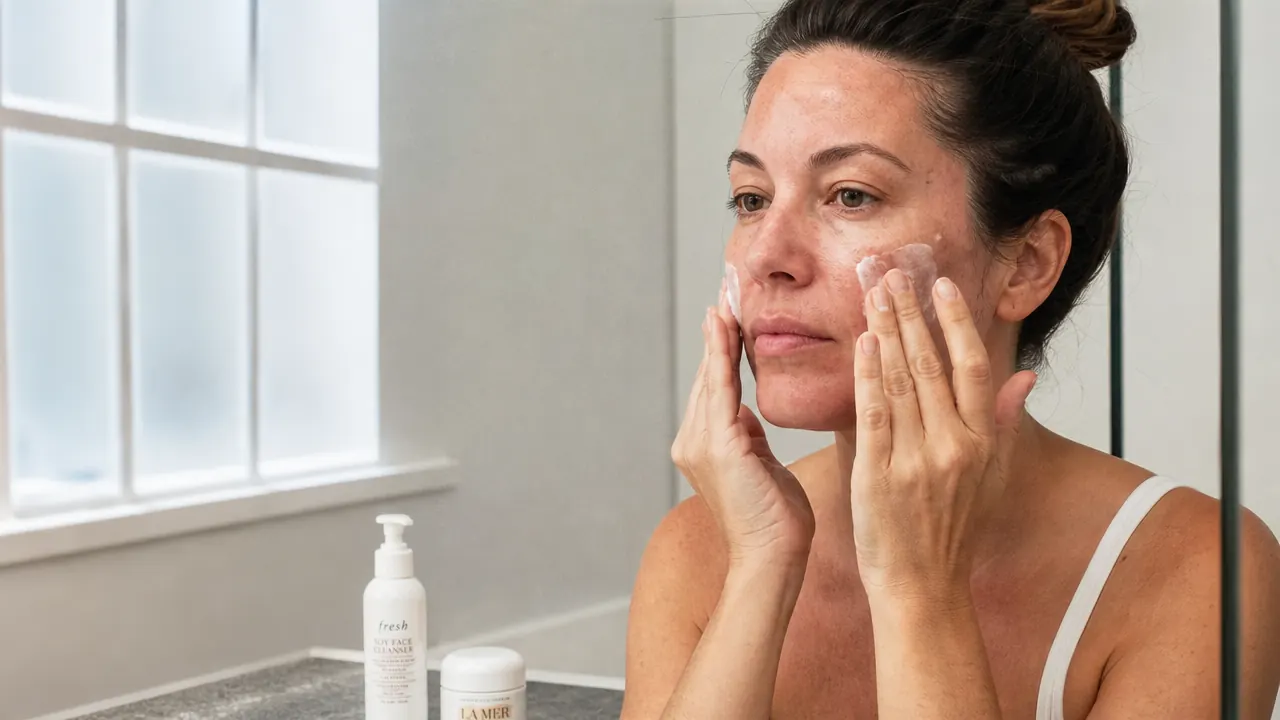
There's a specific kind of skin problem that no serum fixes, no toner helps, and no amount of layering improves. Your skin is tight five minutes after cleansing. Moisturizer stings when it hits your cheeks. A product you've used for months suddenly causes redness. You break out even though you're barely wearing makeup. What you're describing isn't a hydration problem or a sensitivity problem in the usual sense. It's a compromised skin barrier, and the approach that repairs it is almost the opposite of what most skincare routines involve.
I've been through this twice: once in my early 30s after a salicylic acid-and-retinol combination that I used daily for three months, and again at 37 after a chemical peel that was probably a level too aggressive for my combo skin. Both times, the fix was the same: strip the routine to almost nothing, anchor it with a ceramide-rich moisturizer, and wait. This guide is what I wish someone had handed me both times, with the exact steps, the right product, and the honest answer to how long repair actually takes.
Your skin is stinging at moisturizer. That's the barrier telling you it needs ceramides, not more actives.
La Roche-Posay Toleriane Double Repair contains three essential ceramides, niacinamide, and prebiotic thermal water. It's fragrance-free, oil-free, and rated 4.6 stars across more than 49,000 Amazon reviews. It's the moisturizer I anchor every barrier repair protocol around.
Amazon Check Today's Price on Amazon →Step 1: Confirm It's Actually Your Barrier (and Not Something Else)
Before you strip your routine down to nothing, make sure you're dealing with a barrier problem and not a reaction to a single product, a hormonal flare, or contact dermatitis. Barrier damage has a recognizable fingerprint: stinging or burning when water or a gentle cleanser touches your skin, tightness that persists after moisturizing, increased sensitivity to products that previously caused no reaction, and breakouts that follow the same pattern as over-exfoliated skin, meaning small, surface-level congestion across the cheeks and chin rather than the deeper cystic type.
The most common causes are over-exfoliation (too many acids, too often), retinoid overuse without a gradual ramp, extended use of alcohol-heavy toners, harsh cleansers that strip the lipid layer, or any procedure that physically disrupts the stratum corneum. If you can point to a single change in your routine that preceded the sensitivity, that's almost certainly your culprit. Stop it completely before moving to Step 2.
If you genuinely can't identify a cause and the sensitivity appeared without any change in routine, see a dermatologist before self-treating. Rosacea, eczema, and perioral dermatitis all present with symptoms that look like barrier damage but require different management. Barrier repair won't hurt you, but it won't resolve a condition that needs a prescription topical either.
Step 2: Cut Your Routine to Three Products Maximum
This is the hardest step for anyone who has built a multi-step routine over years. The instinct when your skin is reactive is to add: a calming serum, a barrier mist, a sleeping mask. Resist it. Every additional product is another potential irritant, another penetration enhancer pulling actives deeper than your damaged barrier can handle, another thing your skin has to process when it's already overloaded. The three things you need are a gentle cleanser, a ceramide-rich moisturizer, and SPF. That's it. Full stop.
For cleanser: fragrance-free, surfactant-gentle, no exfoliants, no AHAs or BHAs. A cream or gel cleanser that doesn't foam aggressively. For moisturizer: this is where ceramides do the structural work, and I'll cover the right product in the next step. For SPF: a mineral formula with zinc oxide is the safer choice during repair because chemical filters can sting on compromised skin. If your SPF stings, switch to mineral for the duration of the protocol. Everything else, including vitamin C, retinol, exfoliants, essences, and serums, comes back only after your barrier is repaired and your skin can tolerate actives again. That threshold is covered in Step 5.
Step 3: Apply Ceramide Moisturizer Correctly and Consistently
Ceramides are a class of lipids that make up roughly 50 percent of the skin's stratum corneum. They sit in the spaces between skin cells, forming the mortar that holds the structure together and controls transepidermal water loss. When you over-exfoliate or use too many active ingredients, you erode that lipid matrix. The skin becomes permeable, water escapes, and irritants penetrate more easily. Replenishing ceramides topically allows the skin to rebuild the lipid matrix while your natural ceramide synthesis catches up.
La Roche-Posay Toleriane Double Repair is the moisturizer I keep coming back to for barrier repair specifically because the formula is built around this mechanism. It contains ceramide-3, ceramide-6-II, and ceramide-1 (the three ceramides most critical to barrier function), combined with niacinamide, which supports the skin's natural ceramide production from the inside, and prebiotic thermal water, which helps restore the microbiome component of barrier health. The formula is fragrance-free, paraben-free, and oil-free, so it works across combination and oily skin types without clogging.
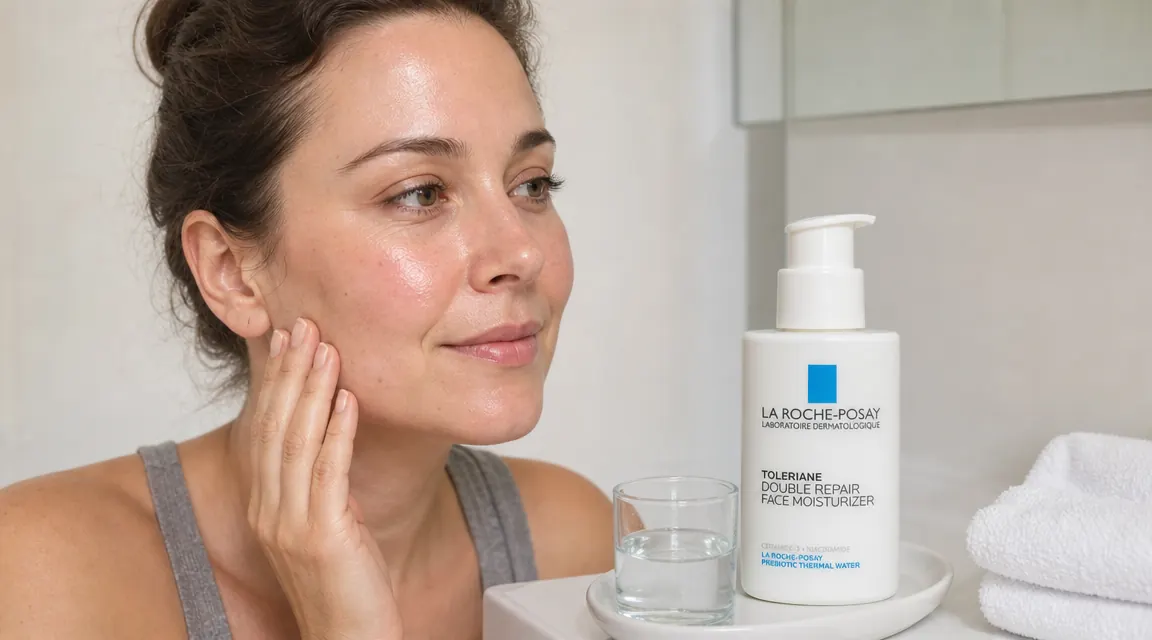
Application technique matters more than most people realize during repair. Apply to skin that is still slightly damp after cleansing, meaning towel-dry but not bone dry. This traps a small amount of water against the surface, which ceramides then help lock in. Use enough product to feel a slight occlusive film but not so much that the skin looks greasy. Morning and evening, every day, for the duration of the protocol. No exceptions, not even on the days when skin seems fine, because that improvement can reverse quickly if you skip the evening application during the first two weeks.
Step 4: Give the Protocol Four Weeks Before Evaluating
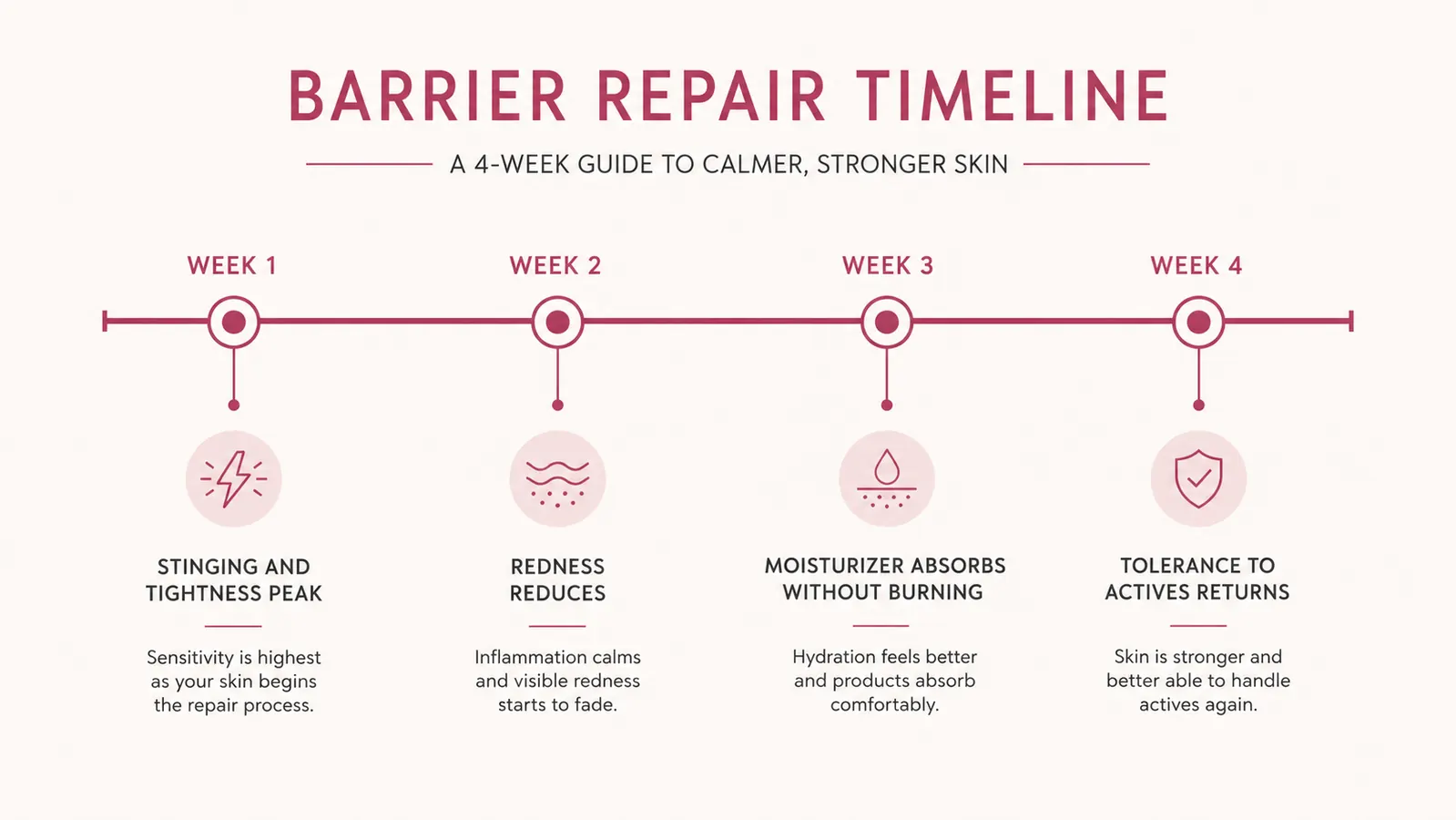
The first week of barrier repair often feels worse before it feels better. The skin is releasing inflammation that built up under the previous stressful routine. You may see more dryness, some flaking at the corners of the nose and mouth, continued redness, or small breakouts as congestion clears. This is normal. What you are looking for in week one is not dramatic improvement but a slowing of the reactive pattern: skin that burns a little less, tightness that resolves a little faster after cleansing.
By the end of week two, most people with moderate barrier damage (caused by actives overuse rather than a procedure) notice that the ceramide moisturizer absorbs without stinging. The stinging-at-moisturizer test is a reliable proxy for barrier status. If it stings when you apply La Roche-Posay Toleriane Double Repair in week one, that response should be largely gone by day 14. If it isn't, the damage is more significant or something in your three-product routine is still causing irritation.
If your moisturizer stings going on, that's barrier damage talking. When that stinging stops, your repair is on track.
Week three is when the skin surface texture starts to normalize. Flaking reduces, pores look less congested, and the skin has a slightly plumper, calmer appearance. By week four, the majority of people with barrier damage from actives overuse have returned to a functional baseline: no stinging at water or cleanser, moisturizer absorbs without burning, and the skin responds to light touch without redness. At that point, you have the option to re-introduce actives, but only one at a time and only on a schedule (see Step 5).
Step 5: Re-Introduce Actives the Right Way (and Know If You're Ready)
The standard test for whether your barrier is ready for actives is straightforward: apply the ceramide moisturizer on clean, dry skin. If there is zero stinging, zero burning, and no reactive redness within five minutes, your barrier is likely functional enough to tolerate a low-concentration active. If any of those three symptoms are present, you need more time on the stripped-back protocol.
When you do re-introduce, start with the lowest-disruption active that addresses your primary concern. Niacinamide at 10 percent is a reasonable first re-introduction because it's well-tolerated by most skin types, supports ceramide synthesis, and provides multiple benefits with minimal irritation risk. Acids and retinol come back last, and they come back at the lowest available concentration, no more than two to three times a week, with a ceramide moisturizer applied immediately after on top.
Wait a full week between each re-introduction. If your skin responds with any sign of barrier stress (stinging at water, redness that persists for hours, the tight feeling returning), that active isn't ready yet. Go back to the three-product protocol for another week before trying again. The ceramide moisturizer stays in your routine permanently as a baseline layer. It isn't a treatment product you cycle off. It's the structural foundation that keeps the barrier maintained whether you're running actives or not.
What Else Helps During Barrier Repair
A few adjustments outside the bottle make a real difference. First, temperature: wash your face with lukewarm to cool water only. Hot water is a fast and consistent barrier disruptor because it breaks down the lipid layer with the same mechanism as a harsh cleanser. If your shower runs hot, wash your face before you get in, or turn the temperature down for the face rinse. Second, friction: pat skin dry with a clean, soft cloth. Rubbing at compromised skin tears at the fragile lipid matrix you're trying to rebuild. Third, environment: extremely low indoor humidity (common in winter) accelerates transepidermal water loss even when you're consistently moisturizing. A basic bedroom humidifier set to 40 to 50 percent makes a measurable difference during the first two weeks.
Diet and hydration matter less than the internet suggests, but they're not irrelevant. Staying well-hydrated keeps the dermis from drawing water upward through the barrier, which can slow repair. Omega-3 fatty acids support ceramide synthesis from the inside, though supplementation timelines are long (8 to 12 weeks before any measurable skin effect). Don't overcomplicate this. The three products, the four weeks, and the temperature and friction adjustments do most of the work. Everything else is secondary.
One thing that doesn't help: switching moisturizers every week to find something better. The urge to shop your way out of barrier damage is strong, but constantly introducing new formulas slows repair because every new ingredient is a potential trigger. If you've already started with La Roche-Posay Toleriane Double Repair and it isn't stinging, stay on it. Consistency with one known-safe product is more effective than cycling through multiple ceramide options. I've covered how it stacks up against the other major ceramide moisturizer on the market in the comparison if you want to read the full breakdown before committing. See my full comparison of La Roche-Posay Toleriane Double Repair vs CeraVe Moisturizing Cream for the ingredient-by-ingredient analysis.

If you want to understand how this moisturizer performs over a longer timeline on a reactive skin type, the six-month review of La Roche-Posay Toleriane Double Repair covers what changes after the acute repair phase when you keep it in rotation as a daily moisturizer.
Four weeks, three products, one ceramide anchor. That's the whole protocol.
La Roche-Posay Toleriane Double Repair contains the three ceramides your barrier is depleted of, plus niacinamide to support natural ceramide synthesis. Fragrance-free, oil-free, and rated 4.6 stars by over 49,000 people who bought it specifically for reactive and sensitized skin.
Amazon Check Today's Price on Amazon →