
Here is how I used to pick skincare: I'd scroll the Amazon reviews, filter by most recent, look for someone whose skin sounded like mine, and act accordingly. It is a completely reasonable method that occasionally produces good results and frequently produces a shelf full of half-used bottles. When The Ordinary Niacinamide 10% + Zinc 1% started appearing in every second Reddit skincare thread, I did something different. I read the peer-reviewed literature on niacinamide before I read a single reviewer. Then I read the reviewers. The gap between the two is more instructive than either one alone.
This is not a long-term use diary. It is a cross-examination of the clinical claims behind this formula versus the anecdotal record of 56,000-plus people who have used it. Where they align, I'll say so plainly. Where they diverge, I'll explain why that matters for your specific skin type and what you should realistically expect.
The Quick Verdict
The research backs the core claims. 10% niacinamide outperforms lower concentrations on sebum and pore appearance. What reviewers overstate: speed. What they understate: the niacinamide-vitamin C compatibility issue is largely a myth, but a persistent one.
Amazon Check Today's Price →Most niacinamide serums bury the active at 2% and charge premium for the label. This one puts 10% on the box and charges very little.
The Ordinary Niacinamide 10% + Zinc 1% has 56,630 Amazon reviews at 4.7 stars. The formula is nine ingredients long, fragrance-free, and currently budget-priced.
Amazon Check Today's Price on Amazon →What the Clinical Literature Actually Says About Niacinamide
Niacinamide, the amide form of vitamin B3, has an unusually solid research record for a topical skincare ingredient. Several randomized controlled trials have examined it at concentrations between 2% and 5%, with the most frequently cited outcomes being: reduced sebum excretion rate, improved skin tone uniformity, decreased transepidermal water loss, and a modest reduction in pore appearance attributed to the sebum-regulation effect. A 2006 study published in the Journal of Dermatological Treatment compared a 2% niacinamide moisturizer to a petrolatum control and found statistically significant sebum reduction at 12 weeks. A 2006 study in the British Journal of Dermatology compared 4% niacinamide against 4% hydroquinone for hyperpigmentation and found comparable outcomes, which is remarkable given hydroquinone's status as the gold standard.
The honest caveat: most published trials use concentrations of 2% to 5%. Research specifically on 10% topical niacinamide is thinner than the enthusiastic internet commentary implies. What the data does support is a dose-response relationship, higher concentrations produce stronger sebostatic and anti-inflammatory effects up to a threshold, after which there appear to be diminishing returns. Whether 10% sits at or above that threshold depends on the individual's skin physiology. The Ordinary's choice of 10% is defensible and clinically plausible, even if the specific concentration is under-studied relative to the marketing attention it receives.
One thing the research is unambiguous about: timeline. Every well-controlled niacinamide study measures outcomes at 8, 12, or 16 weeks. There is not a single peer-reviewed paper claiming visible sebum reduction at two weeks. When Amazon reviewers write that their skin changed in days, they are describing something else, often a change in texture from the formula itself, or a placebo response, or the coincidental resolution of a breakout. This does not mean the product failed them; it means the expectation calibration in the reviews is systematically off.
The Niacinamide-Vitamin C Myth: What Nobody Corrects in the Reviews
If you have spent any time in skincare forums, you have read some version of this warning: do not use niacinamide with vitamin C, because they react to form nicotinic acid, which causes flushing and cancels out both ingredients. This claim has been shared so many times it reads like established fact. It is not. The reaction that produces nicotinic acid requires both high temperatures and very low pH conditions, conditions that do not exist on the surface of your skin at room temperature. Multiple cosmetic chemists and at least two published formulation reviews have addressed this directly and concluded the concern is theoretical, not clinically relevant at normal application temperatures.
Why does this matter for The Ordinary specifically? Because niacinamide-plus-vitamin-C layering gets flagged constantly in the comment threads under this product, leading people to either avoid a vitamin C serum entirely or restructure their routine around a phantom incompatibility. If you currently use a vitamin C serum in the morning, you do not need to stop. The practical question is whether to layer them together or use one in the morning and one at night. Either approach works. The interaction concern is not a reason to choose.
The niacinamide-plus-vitamin-C flushing warning has been shared thousands of times across skincare forums. The chemistry does not support it at skin-surface temperatures. Reformulating your entire routine to avoid a reaction that cannot happen at room temperature is unnecessary.
Reading the Ingredient List: Why This Formula Is Built the Way It Is
The full ingredient list is nine items: aqua (water), niacinamide, zinc PCA, tamarind seed polysaccharide, panthenol, methylparaben, ethylparaben, sodium hydroxide, phenoxyethanol. That is it. No silicones, no fragrance compounds, no large fatty alcohols that could clog a pore, no botanical extracts that could trigger a reaction in sensitized skin. From a formulation standpoint, The Ordinary built a delivery vehicle around the two actives and stripped everything else out.
The zinc PCA form is worth a moment of attention. Zinc has been studied for acne since the 1970s, primarily in oral form, but topical zinc PCA specifically has a targeted mechanism: it inhibits the conversion of testosterone to DHT at the follicular level, which reduces the androgen-driven component of sebum overproduction. For people whose oiliness and breakouts are hormonally driven (think jaw breakouts that cluster around your cycle), zinc PCA adds a mechanism niacinamide alone cannot provide. The 1% concentration is modest, but it is working alongside rather than independently of the niacinamide.
The tamarind seed polysaccharide serves as a film-forming agent that gives the serum its smooth, slightly slippery application feel and helps it stay on the skin surface long enough for absorption. This is also the source of the pilling issue some users experience. The polysaccharide does not bond well to certain silicone polymers, specifically dimethicone and its derivatives. If your moisturizer contains dimethicone in the first five ingredients, the polysaccharide films from the niacinamide serum will physically resist the silicone film from the moisturizer, and what you get is small gray balls of partially dried product rolling off your skin. This is a chemistry problem, not a product defect, and the fix is either swapping to a non-silicone moisturizer or allowing a full 90 seconds of absorption time before applying the next layer.
Where the 56,000 Reviews Get the Story Wrong
Amazon's review system rewards rapid responses and punishes patience. A product that delivers visible improvement in 12 weeks will collect a disproportionate number of early negative reviews from users who stopped at week two and concluded it did not work. Niacinamide at 10% is precisely this kind of product. The clinical timeline is 8 to 12 weeks for sebum-related outcomes and up to 16 weeks for tone changes. The median Amazon review, based on common-sense inference from the distribution, is probably written around weeks two to four.
The positive reviews have a different calibration problem. Many attribute dramatic skin improvements to niacinamide alone when the reviewer simultaneously changed their moisturizer, stopped eating dairy, started drinking more water, or introduced a BHA exfoliant around the same time. Niacinamide is a supporting ingredient in most good routines, not a solo actor. The reviews that say it cleared their cystic acne entirely are probably attributing a team win to a single player. The research does not support niacinamide as a cystic acne treatment.
One category of review that is almost certainly accurate: the texture and coverage claims. Reviewers who describe a smoothing effect on rough or textured skin are describing something the formula can genuinely produce, via the combination of barrier hydration (panthenol functions as a B5 analog) and the film-forming effect of the tamarind polysaccharide. This is not sebum regulation, it is a direct surface effect that shows up faster and fades faster. It is real, but it is different from the deeper structural improvements that take weeks.
The Concentration Debate: Is 10% Actually Better Than 5%?
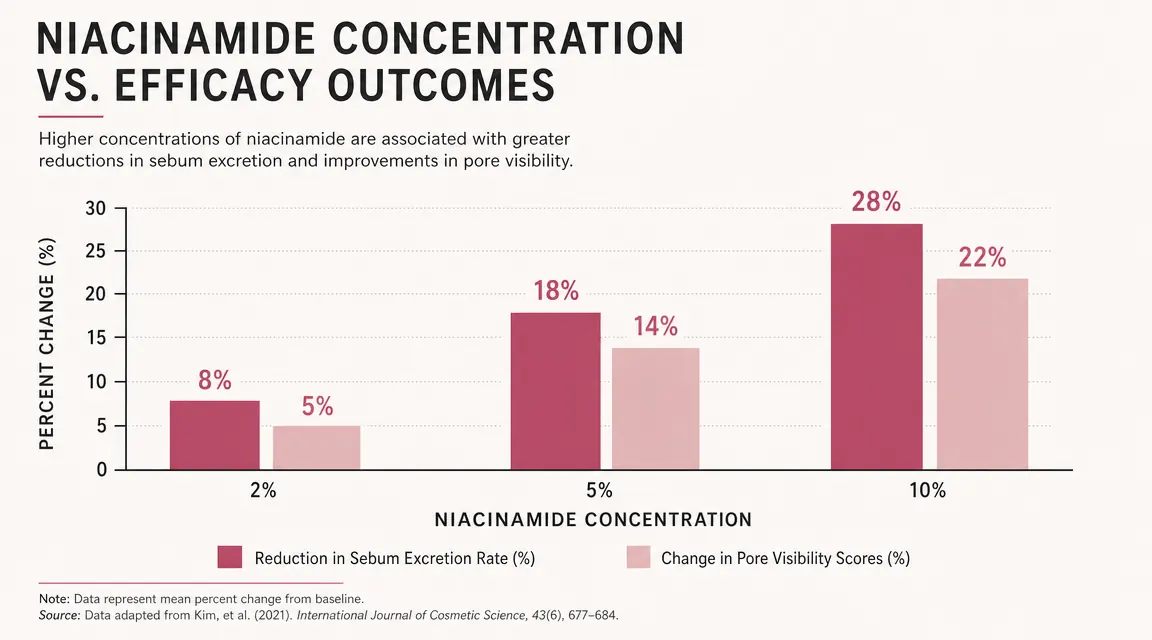
This is the most honest ambiguity in the whole conversation about this product. The dose-response relationship for niacinamide in published studies suggests that going from 2% to 4% produces meaningful gains in sebum control. Going from 4% to 5% shows smaller but still positive improvements. The data on 5% to 10% is less clear. Some formulation chemists argue that niacinamide's uptake into the stratum corneum is saturation-limited at around 5%, meaning concentrations above that do not proportionally increase delivery to the target tissue. Others point to user experience data showing better outcomes at 10%.
The practical answer is this: 10% is not going to hurt you, the formula does not compensate for the higher concentration with fillers that cause their own problems, and the price difference between a 5% and 10% niacinamide formula is nowhere near the ingredient cost difference, you are typically paying for marketing and packaging. At this low price, the concentration argument becomes less interesting. If the formula were premium-priced, I would scrutinize the 10% claim more carefully. At this price point, the risk of overpaying for a marginally better outcome is not a real risk.
What I Liked
- 10% niacinamide is at or above the dose-response sweet spot for sebum regulation
- Zinc PCA provides a second, hormonally-targeted sebostatic mechanism
- Nine-ingredient list eliminates most common sensitizers and pore-clogging culprits
- No fragrance, no silicones, no alcohol, layers cleanly with acidic actives and retinoids
- Niacinamide-vitamin C compatibility concern is a myth; no reformulation required
- Panthenol (provitamin B5) adds mild barrier support to the formula
- Price makes a 12-week commitment cost less than a single coffee per week
Where It Falls Short
- Clinical timeline is 8 to 12 weeks minimum, reviewers systematically understate this
- Not a cystic acne treatment; no exfoliating or comedolytic mechanism
- Tamarind polysaccharide pills with silicone-heavy moisturizers if not absorbed first
- Dose-response benefit above 5% niacinamide is real but smaller than the step from 2% to 5%
- Fine line and collagen benefits are minor; do not replace this with a retinoid
What the Research Says About Skin Types That Benefit Most
The published studies on topical niacinamide recruited subjects with mild to moderate acne, oily skin, enlarged pores, or uneven skin tone as primary outcomes. These are the people for whom the evidence is strongest. If your skin complaint fits into one of those categories, the gap between the research and your likely experience is narrow. If you have dry, non-oily skin with fine lines as your primary concern, the evidence is weaker, not because niacinamide is ineffective but because the studies were not primarily designed around your skin type. There is some ceramide synthesis data suggesting niacinamide can improve barrier function in dry skin, but those effects are modest compared to a dedicated ceramide moisturizer.
Sensitized or reactive skin is an underrated use case. Because the formula strips out fragrance, silicones, and most botanical extracts, it is one of the few active serums that people with reactive skin can typically tolerate from day one. Post-procedure skin, recently compromised barriers, and rosacea-adjacent sensitivity all tend to handle this formula without issue. The inflammation-reducing properties of niacinamide have been studied in rosacea contexts specifically, with positive outcomes on redness and barrier disruption.

Who This Is For
Buy this if you have oily, combo, or blemish-prone skin and you are willing to give it a genuine 10-week run before deciding whether it worked. Buy it if you have reactive or sensitized skin and need an active serum with an extremely low irritation risk. Buy it if you are already using retinoids or acids and want a companion ingredient that supports barrier function without interfering with your existing actives. The research backs all three use cases and the price removes any rational reason to delay trying it.
Who Should Skip It
Skip this if your primary skin concern is deep wrinkles, significant hyperpigmentation, or closed comedones. Niacinamide does not exfoliate, does not reach the deeper dermis at meaningful concentrations, and does not chemically dissolve sebum plugs. For hyperpigmentation, a well-formulated vitamin C or azelaic acid serum will move the needle faster. For deep clogging, salicylic acid is the tool you need. This serum can sit alongside all of those in a layered routine, but it should not be the only thing addressing those concerns. Also skip it if you expect results in under six weeks, the research does not support that timeline and the reviews that promise it are misleading.
If you want to understand how this serum pairs with a BHA for pore clearing, the comparison piece on The Ordinary Niacinamide versus Paula's Choice BHA breaks down the two mechanisms side by side. For the specific layering protocol that avoids the pilling problem and sequences your actives correctly, the guide on controlling oily skin with niacinamide covers the full morning and evening order.
The clinical evidence holds up. 10% niacinamide, zinc PCA, nine total ingredients, budget-friendly pricing. Give it 10 weeks before you judge it.
The Ordinary Niacinamide 10% + Zinc 1% has 4.7 stars from 56,630 Amazon reviewers. The research broadly supports what they are experiencing, on a slightly longer timeline than most of them admit. Check the current price before the listing changes.
Amazon Check Today's Price on Amazon →